





Start with the failure mode, not the quote
When procurement teams compare a bearing remanufacturing supplier, the first mistake is treating every returned bearing as the same kind of job. A low-speed conveyor bearing, a paper machine roll bearing, and a wind or mining application do not carry the same repair risk or downtime cost. If you do not define the service conditions up front, the supplier can only price the visible work, not the real exposure behind it.
Before asking for quotations, build a short intake sheet for each bearing family: bearing type, size, application, operating load, speed, lubrication method, contamination exposure, failure history, and whether the unit is safety-critical or just production-critical. This changes the conversation. Instead of “Can you remanufacture this bearing?” you are asking, “Can you restore this bearing to a condition that makes sense for this duty cycle and cost target?” That is the right commercial question.
A capable bearing remanufacturing supplier should respond by separating bearings into at least three buckets: economically repairable, technically repairable but poor value, and not suitable for remanufacture. If every unit magically looks repairable, treat that as a warning sign.
Check how they decide whether a bearing is worth saving
The real quality gate is not the polishing or grinding itself. It is the inspection discipline before the supplier commits to the job. Ask what happens at incoming inspection and what records you receive before repair approval.
- Do they document raceway damage, corrosion, spalling, smearing, overheating, cage damage, and fit-related wear?
- Can they explain what damage can be restored and what damage changes the risk too much?
- Do they issue a condition report with photos, measured wear, and a recommendation before work starts?
- Is there a clear rejection rule for bearings with cracking, severe sub-surface damage, or geometry loss beyond their process window?
You do not need a lecture on tribology here. You need evidence that the supplier has a repeatable disposition process. Procurement gets burned when the repair decision is based on visual optimism rather than measured condition.
Ask for the process route, not just the promise of “like new”
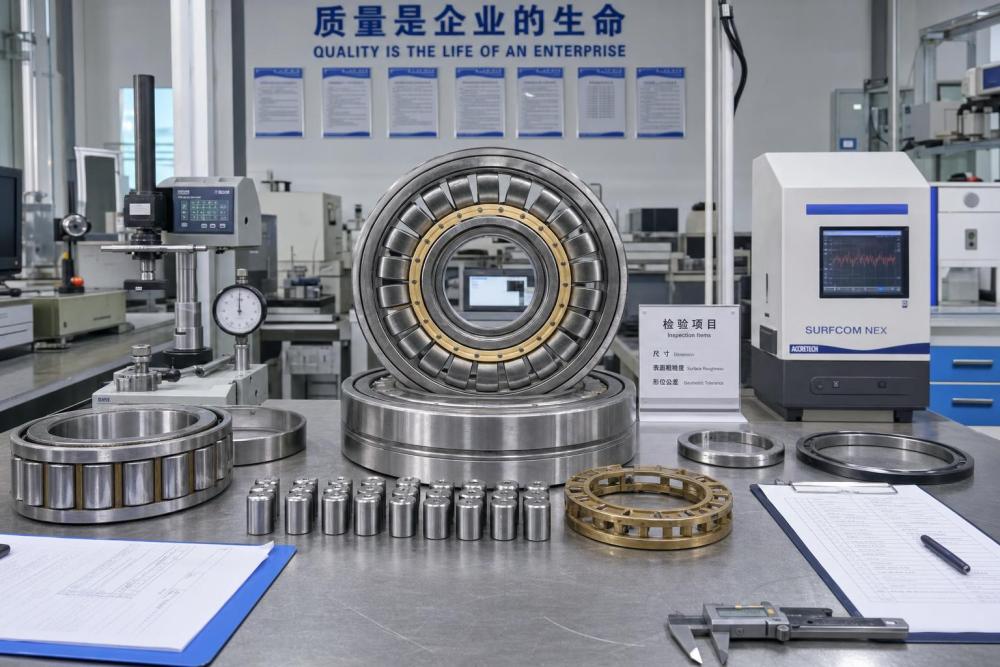
“Like new” is marketing language unless the supplier can map the actual remanufacturing steps. For some bearings, the route may include cleaning, disassembly, dimensional inspection, raceway grinding or superfinishing, rolling element replacement where applicable, cage replacement, heat-treatment checks, assembly, lubrication, preservation, and final inspection. For others, only limited refurbishment may be appropriate.
What you want to hear is not a generic process list, but a process route tied to the bearing type. Large slewing or rolling mill bearings, precision spindle bearings, and standard spherical roller bearings should not all be described with the same script. If they cannot explain where the process differs, they may be operating with a broad sales pitch and a shallow technical screen.
Also ask whether they remanufacture in-house or broker work to another facility. There is nothing automatically wrong with subcontracting, but it changes control, lead time, traceability, and margin structure. You need to know who actually owns the critical operations.
Review inspection capability in practical terms
A supplier can have clean brochures and still be weak where it matters. Focus on inspection methods that support the risks in your application. For procurement, the useful question is simple: what defects can they detect before the bearing goes back into service?
Look for capability around dimensional measurement, surface condition evaluation, runout or geometry checks where relevant, and non-destructive examination if the bearing category and damage mode justify it. You do not need every possible test on every order. You do need a logic for when deeper inspection is required. A supplier serving heavy industrial MRO work should be able to explain that logic clearly.
One useful check during supplier review: ask them to walk through a rejected bearing file and a successfully remanufactured file. You will learn more from their exceptions than from their standard sales deck.
Do not separate quality control from engineering judgment
Good remanufacturing is not just machining plus inspection. Someone has to decide whether the restored geometry, internal clearance, surface finish, and component replacement plan still fit the application. That is engineering judgment, and it affects cost control more than buyers often expect.
Here is a useful difference to look for. A weak supplier talks about restoring the bearing. A strong one talks about restoring function in service. That means they ask about lubrication practice, shaft and housing fits, contamination control, handling damage, and why the original bearing failed. If they never ask how the bearing was used, they are pricing a workshop operation, not a reliability outcome.
Break down the quote until hidden cost disappears
Price comparison gets messy because many quotations blend inspection, repair, replacement parts, testing, preservation, and logistics into one figure. That makes cheap quotes look efficient when they may simply be excluding work you will pay for later.
Ask each supplier to separate cost into the same categories. A simple comparison table usually exposes where the real differences are.
This is where cost control becomes real. You are not chasing the lowest nominal price; you are trying to avoid rework, repeat failures, and downtime caused by poor scoping.
Lead time matters, but so does lead-time discipline
In remanufacturing, quoted lead time often depends on what the incoming inspection reveals. That is normal. What matters is whether the supplier can show stage gates: receipt, inspection report, approval point, repair, final inspection, and shipment. Without those gates, urgent orders become blind waiting.
Ask how they handle three situations: emergency turnaround, bearings that fail incoming inspection, and jobs waiting on replacement components. If the answer to all three is some version of “we will update you,” the control system is weak. Buyers need a predictable escalation path, especially when the bearing supports a shutdown-critical asset.
Check documentation the way receiving and audit teams will use it
Procurement often focuses on technical capability, then gets stuck later because the paperwork does not support internal approval, warranty handling, or vendor scorecards. Ask for sample deliverables before the first order. Not polished examples made for marketing, but ordinary job documents.
- Incoming inspection report
- Repair scope approval format
- Final inspection or release document
- Traceability method linking the bearing to the job record
- Packaging and preservation details for storage or export handling
The point is not bureaucracy. It is control. If a bearing fails early, you need records that tell you whether the problem was pre-existing damage, repair scope, installation practice, lubrication, or application mismatch.
Treat warranty language as a process clue
Warranty terms are often less useful as legal protection than as a window into how the supplier thinks. A serious supplier will define what is covered, what operating conditions matter, what evidence is needed in the event of failure, and what exclusions apply to storage, mounting damage, contamination, or misuse.
Be careful with broad promises that are not tied to documented release criteria. They sound good at sourcing stage and become hard to enforce later. In practice, a narrower but clearly structured warranty is often more bankable than a vague “full guarantee.”
Look at total economics across the bearing population
One-off job pricing does not tell you much if you manage a large installed base. The stronger buying approach is to review the supplier’s fit across your bearing population: which sizes and types are usually good remanufacturing candidates, which are borderline, and which should go straight to replacement. This is where a supplier can help reduce cost, or quietly increase it through poor screening.
A practical sourcing question is: what percentage of our returns are likely to be rejected after inspection, and how do you minimize freight and handling waste on those units? You are not looking for a made-up percentage. You are looking for a method. Some suppliers help clients pre-screen based on photos, damage history, and application notes before shipping heavy bearings across regions. That saves money even when no repair order is placed.
Run a pilot that is hard enough to be meaningful
Do not qualify a bearing remanufacturing supplier with the easiest bearings in your storeroom. Choose a pilot batch that reflects the work you actually care about: mixed condition, mixed urgency, and at least one unit where the economics are not obvious. Then score the supplier on the things that matter in real operations.
- Quality of incoming assessment
- Clarity of repair versus reject decisions
- Quote transparency after inspection
- Lead-time performance against each stage
- Usefulness of final documentation for your internal controls
This gives procurement, maintenance, and reliability teams something concrete to compare. It also reduces the usual argument between the cheapest quote and the safest choice.
Make the award decision in the right order
A solid decision sequence is simple. Screen for technical fit first. Then review inspection and disposition discipline. After that, compare commercial transparency, lead-time control, and documentation quality. Price belongs near the end, once you know the quotations are talking about the same scope.
If you compress all of this into a single rule, use this one: choose the supplier whose process makes bad decisions hard. In bearing remanufacturing, that is what protects both quality and cost. A supplier that rejects the wrong bearings, accepts the wrong bearings, hides scope in the quote, or documents work poorly will cost more than the invoice suggests. A supplier with disciplined inspection, clear repair limits, and transparent costing usually earns back the difference quickly.
For the next sourcing round, build your checklist around three documents: the incoming inspection report, the post-inspection quote, and the final release record. If those three are strong, most of the supplier’s real operating discipline will be visible before you commit serious volume.
Want to dive deeper into these market dynamics, or need data-driven support for your next business move? Drop a line below and let the analysts at PCTS provide customized insights.
We respect your privacy. Your information is strictly confidential.
Related News
- 00
0000-00
How sealing technology reduces contamination in semiconductor manufacturing - 00
0000-00
Where to install vibration sensors on rotating machinery - 00
0000-00
NTSB Probe Finds Boeing Warned of MD-11 Engine Bearing Risk Years Earlier - 00
0000-00
How to size pneumatic grippers for packaging system integration - 00
0000-00
How to size alloy steel power transmission chains for heavy loads
Weekly Insights
Stay ahead with our curated technology reports delivered every Monday.