





In today’s volatile manufacturing environment, every hour of downtime and every dollar tied up in excess inventory directly erode margins. Optimizing the industrial MRO supply chain is no longer just a maintenance issue—it is a strategic priority for business leaders seeking higher equipment reliability, faster response, and lower total operating costs. This article explores how smarter sourcing, inventory planning, and supplier coordination can reduce disruption while improving long-term performance.
For many executive teams, the problem appears contradictory. Plants want to avoid line stoppages, so they build safety stock. Finance wants working capital released, so it pushes inventory down. Procurement wants fewer suppliers for leverage and efficiency, while maintenance wants immediate access to hard-to-find parts from whoever can deliver fastest. These tensions are normal. The mistake is treating them as separate problems rather than as one system-level decision inside the industrial MRO supply chain.
That distinction matters because MRO is unlike direct materials. Production inputs are usually forecastable, standardized, and tied to customer demand. MRO demand is more erratic. A failed bearing, leaking seal, broken coupling, contaminated hydraulic filter, or damaged pneumatic valve can shut down a line without warning. In that environment, cost control cannot be reduced to unit price. The real question is which supply chain design minimizes the total cost of failure.
Why MRO cost reduction often fails in practice
Many companies still pursue MRO savings through annual price negotiations, supplier consolidation, or blanket inventory cuts. Those actions can help, but only if the underlying failure modes are understood. Otherwise, they create a hidden tradeoff: lower purchase prices alongside higher downtime exposure.
The most common failure is over-focusing on catalog price while underestimating interruption cost. A lower-cost seal or bearing that arrives with inconsistent dimensions, shorter service life, or poor traceability can trigger repeat failures that dwarf any purchasing savings. The same applies when a distributor promises broad coverage but cannot support urgent technical substitutions or validate interchangeability under operating loads, speeds, pressure, or chemical exposure.
A second failure is poor criticality segmentation. Not all MRO items deserve the same stocking policy. Standard fasteners, basic pneumatic fittings, and common V-belts should not be governed the same way as spindle bearings, hydraulic pumps, mechanical seals for corrosive media, or long-lead imported gearboxes. When companies apply one inventory rule across all categories, they usually overstock low-risk parts and under-protect the assets that actually drive plant vulnerability.
A third issue is fragmented ownership. Procurement, maintenance, engineering, and finance often work from different definitions of value. Procurement tracks price variance, maintenance tracks response time, engineering tracks performance, and finance tracks inventory turns. Without a shared decision model, each function optimizes locally and the enterprise absorbs the resulting inefficiency.
Start with asset criticality, not SKU count
Executives trying to cut downtime and carrying costs should begin at the asset level. The meaningful unit of analysis is not how many part numbers are in the storeroom, but which machines create the most operational and financial exposure when they fail.
A useful framework is to group MRO demand around three questions: what fails most often, what stops production fastest, and what takes longest to recover. Those categories overlap, but not perfectly. A low-cost O-ring may fail frequently without major disruption if replacement is simple and stock is nearby. A specialized bearing may fail rarely but create a severe outage if lead times are long and installation requires alignment expertise. A hydraulic servo component may be available, but delayed restart could still occur if contamination control, commissioning, or calibration takes time.
That is why leading companies classify MRO items by business impact rather than commodity family alone. The stocking logic for chains, belts, seals, bearings, hydraulic cylinders, and pneumatic actuators should reflect the criticality of the equipment they support. A packaging line, steel mill, semiconductor tool, mining conveyor, or wind turbine gearbox will justify very different service levels and risk buffers.
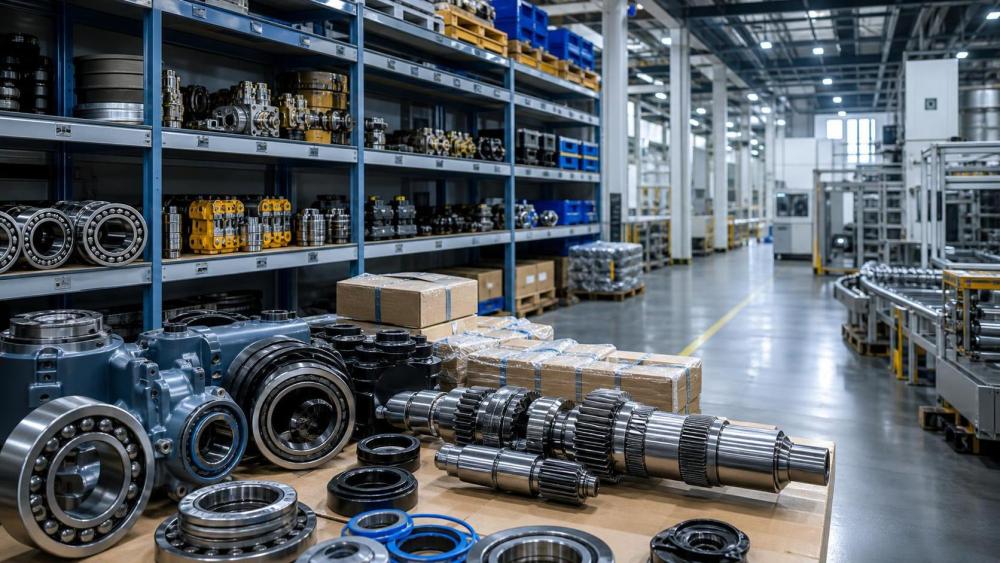
Once asset criticality is mapped, management can make more disciplined decisions about where inventory belongs. Some parts should be stocked on site. Some are better held regionally by a trusted distributor. Some can be sourced on demand if alternative suppliers are prequalified. And some should be redesigned out of the process if they repeatedly create downtime.
Reduce carrying costs by eliminating “false security” inventory
Many storerooms look well supplied but are strategically weak. They hold years of slow-moving stock, obsolete components from retired equipment, duplicate part numbers created by naming inconsistencies, and low-value items purchased “just in case.” This inventory creates the illusion of preparedness while consuming cash, space, and labor.
The strongest carrying cost reductions usually come from cleaning data before cutting stock. Part master rationalization matters more than many companies expect. If the same bearing is listed under OEM code, local language description, distributor shorthand, and legacy ERP number, planners cannot see true consumption. That drives overbuying and masks shortages.
Obsolescence is another overlooked cost. In MRO, obsolete inventory often accumulates quietly after machine upgrades, supplier changes, or design revisions. If no disciplined review exists, companies keep insuring themselves against failures on assets they no longer operate. A serious MRO cost program should identify dormant stock, validate whether the supported equipment is still active, and determine whether parts can be redeployed, returned, or liquidated.
Carrying cost improvement also depends on understanding shelf-life and storage risk. Seals, lubricants, adhesives, certain elastomers, and sensitive pneumatic or electronic components can degrade in storage. That means excess inventory is not merely idle cash; it may become unusable before it is ever installed. For decision-makers, this changes the logic from “more stock is safer” to “the right stock in the right condition is safer.”
Supplier strategy should be built around response capability, not vendor count alone
Supplier consolidation remains attractive because it can simplify administration and improve spending visibility. But in the industrial MRO supply chain, fewer suppliers do not automatically mean lower risk. The key question is whether the remaining suppliers can support technical breadth, emergency response, and reliable substitution without compromising equipment performance.
For standard consumables, aggregation often works well. For critical rotating, sealing, fluid power, and transmission components, the picture is more nuanced. A distributor with strong local inventory but weak engineering support may not be enough. Likewise, buying directly from multiple manufacturers may secure better pricing on paper while increasing lead-time variability, freight complexity, and accountability gaps.
Decision-makers should evaluate suppliers on a broader scorecard that includes:
- fill rate on critical items, not just overall fill rate;
- expedite capability for emergency orders;
- technical validation of interchangeability and application fit;
- traceability and quality documentation where required;
- regional warehousing footprint and customs resilience for cross-border flows;
- failure analysis support and root-cause collaboration;
- digital integration with ERP, CMMS, or e-procurement systems.
This is especially important for globally sourced parts. A low-cost overseas source may look compelling until port delays, export controls, changing freight rates, or documentation errors interrupt replenishment. For high-criticality components, dual sourcing or hybrid sourcing is often more economical than aggressive single-source concentration.
Downtime falls faster when procurement and reliability teams share data
One of the clearest markers of MRO maturity is whether purchasing decisions are linked to maintenance outcomes. In many firms, they are not. Procurement sees annual spend by vendor. Maintenance sees mean time between failure, response delays, repeat work orders, and emergency requisitions. Those datasets rarely meet in a way that supports executive decisions.
When they do, the conversation changes. A part category that appears expensive may actually reduce total cost because it extends service intervals, lowers labor hours, or prevents collateral damage. Conversely, a “cost-saving” substitution may prove uneconomic if it increases vibration, leakage, contamination, misalignment, or unplanned shutdowns.
For example, bearing procurement should not be evaluated only by purchase price and lead time. Lubrication practices, mounting methods, housing tolerances, contamination exposure, and operating load all influence replacement frequency. The same principle applies to hydraulic and pneumatic systems, where seal material, fluid compatibility, pressure spikes, and particulate control often determine lifecycle cost more than nominal component price.
Executives do not need every technical detail, but they do need an integrated KPI set. Useful measures include emergency purchase ratio, stockout frequency on critical assets, inventory accuracy, supplier on-time performance for A-class MRO items, repeat failure incidence, and total downtime cost associated with sourced replacement parts. Without that linkage, MRO cost programs can become accounting exercises disconnected from operational reality.
Where digital tools create real value—and where they do not
Digitalization is often presented as the answer to MRO inefficiency. In practice, its value depends on the quality of the operating model beneath it. Software will not fix poor part descriptions, undefined asset criticality, or weak supplier discipline. What it can do is make good decisions faster and more visible.
In the current market, the most practical digital gains tend to come from four areas: part master cleanup, demand visibility, predictive maintenance integration, and guided replenishment. A cleaner data structure reduces duplicate inventory. Better demand visibility helps identify which consumables are truly stable and which are event-driven. Condition monitoring can improve planning for bearings, motors, pumps, and gear-driven assets, though it is more effective for critical equipment than for every low-value component in the plant. Guided replenishment can reduce urgent spot buys if lead times and minimum order quantities are kept current.
The caution for business leaders is not to assume that predictive maintenance automatically reduces inventory. Sometimes it does the opposite, because earlier detection increases planned replacement activity and reveals how inadequate current stock policies are. The benefit lies in replacing emergency downtime with scheduled intervention, not in magically eliminating spare-parts demand.
Cross-border sourcing now requires a stronger risk lens
For companies with global footprints or import-dependent maintenance operations, MRO resilience has become more exposed to external volatility. Freight disruptions, geopolitical trade friction, supplier concentration by region, and customs documentation errors can all turn a manageable maintenance event into a prolonged outage.
This does not mean international sourcing should be reduced across the board. It means supply decisions must reflect recovery time objectives. A long-lead imported mechanical seal or precision bearing may still be the right choice if performance advantages are substantial and inventory positioning is disciplined. But if the item supports a high-throughput asset with no practical substitute, management should ask whether local stocking, regional buffer agreements, or secondary sources are necessary despite higher nominal cost.
In sectors with strict quality or regulatory requirements, traceability becomes even more important. Depending on application, buyers may need material certifications, test reports, origin documents, or compliance records from suppliers. Exact requirements vary by industry and market, and should be confirmed case by case rather than assumed. Where compliance is uncertain, the prudent approach is to mark it as 【待核实】 during supplier qualification instead of discovering the gap during an emergency replacement.
The best savings usually come from policy changes, not heroic purchasing
Companies that materially reduce downtime and carrying costs usually do not get there through one-off negotiations. They change operating rules. They define critical spares consistently. They align min-max levels with actual failure and lead-time behavior. They review obsolescence quarterly rather than annually. They prequalify alternates before breakdowns happen. They hold suppliers accountable for service performance, not just invoices.
They also accept that some inventory is economically justified. The goal is not to minimize stock at any cost. It is to avoid paying premium prices for the wrong kind of availability. Carrying a carefully chosen spare hydraulic pump, precision bearing set, or seal kit may be financially rational if it protects a bottleneck asset. Holding six years of miscellaneous legacy parts usually is not.
For enterprise decision-makers, the right question is simple: where does each additional dollar create more value—in the storeroom, with the supplier, or in higher asset reliability? That framing leads to better outcomes than blanket targets for inventory reduction or supplier count.
The industrial MRO supply chain is becoming a board-level issue because it sits at the intersection of uptime, cash flow, and risk. Companies that treat it as a strategic system can lower working capital without exposing operations. Those that rely on price pressure and reactive buying often discover the true cost only after the next line stoppage.
In a tighter margin environment, resilience is no longer a soft benefit. It is an operating advantage that must be designed, measured, and purchased deliberately.
Want to dive deeper into these market dynamics, or need data-driven support for your next business move? Drop a line below and let the analysts at PCTS provide customized insights.
We respect your privacy. Your information is strictly confidential.
Related News
- 00
0000-00
How to check vibration analysis software for sensor compatibility - 00
0000-00
IndexBox Forecasts 3.8% Annual Growth for Global Radial Seals Market Through 2035 - 00
0000-00
How to assess the chemical compatibility of FFKM sealing sheets - 00
0000-00
IndexBox Forecasts 3.6% Annual Growth for Construction Bearings Market - 00
0000-00
When do hydraulic components require an export license?
Weekly Insights
Stay ahead with our curated technology reports delivered every Monday.