





How to Compare Corrosive Gas Control Suppliers on Compliance and Lifecycle Cost
Choosing a corrosive gas control supplier is not only about upfront price.
The real comparison starts with compliance, materials, reliability, maintenance effort, and lifecycle cost.
That matters even more in semiconductor, chemical processing, battery, coating, and specialty gas applications.
A weak supplier may pass a quotation stage but fail under audits, media exposure, or long operating cycles.
A strong corrosive gas control supplier reduces risk before installation and keeps cost predictable after startup.
Start With Compliance Readiness
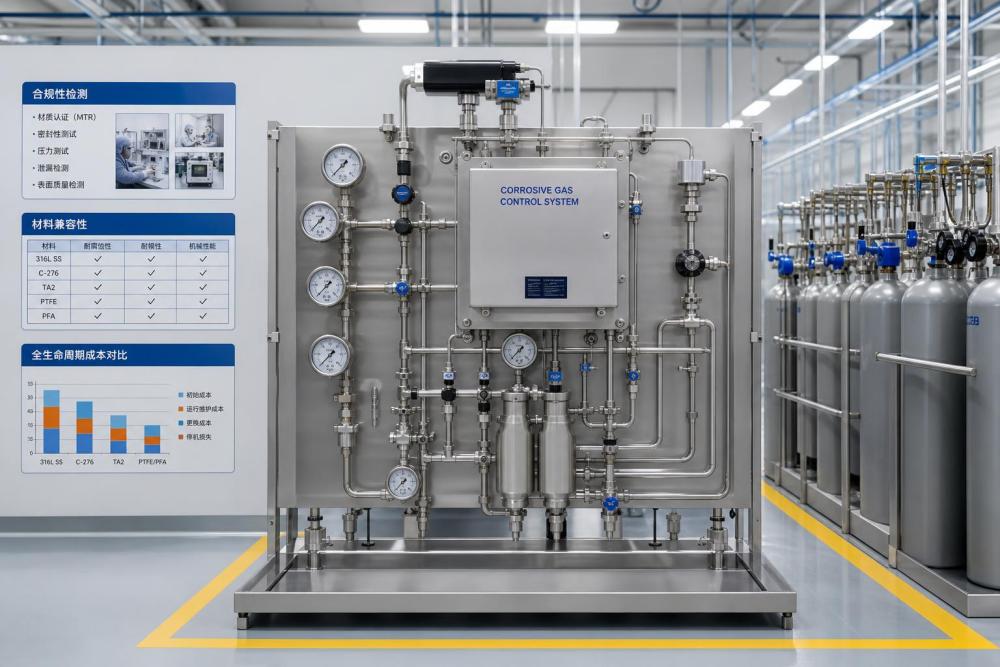
Compliance is the first hard filter when comparing any corrosive gas control supplier.
If the documentation is weak, every later claim becomes harder to trust.
Start by checking which standards apply to the target process and geography.
Common requirements may include ISO systems, pressure equipment rules, hazardous area ratings, and gas handling protocols.
For corrosive media, material traceability is just as important as system certification.
Ask for mill certificates, weld procedures, leak test records, calibration history, and cleaning validation.
A qualified corrosive gas control supplier should provide these without delay.
Slow responses usually signal weak internal controls or poor document management.
What to verify in supplier documents
- Applicable regulatory certificates for the destination market.
- Material certificates for wetted parts and sealing components.
- Leak test methods, acceptance limits, and test frequency.
- Surface finish, passivation, and contamination control records.
- Change control procedures for design, materials, and sub-suppliers.
In actual sourcing work, change control often separates dependable partners from risky low-cost bidders.
A corrosive gas control supplier should not switch elastomers, fittings, or coatings without formal notice.
Check Material Compatibility Beyond Basic Specs
Many supplier comparisons fail because buyers focus on catalog pressure and flow data alone.
Corrosive gas control performance depends heavily on material compatibility over time.
This includes body alloys, valve seats, diaphragms, seals, tubing, surface treatments, and connection hardware.
For example, a suitable alloy for dry gas may fail under moisture, temperature cycling, or mixed media exposure.
That is why the best corrosive gas control supplier asks about full process conditions, not just gas names.
Questions that reveal real material expertise
- What is the exact gas composition, purity, and byproduct profile?
- Will moisture, heat, vacuum, or pressure cycling change corrosion behavior?
- Which sealing materials are used, and why were they selected?
- What field evidence supports the recommendation?
- What failure modes have appeared in similar installations?
A credible corrosive gas control supplier answers with application logic, not generic brochure language.
This is also where supplier knowledge connects with sealing and fluid control experience.
PCTS often highlights how component materials shape reliability, maintenance intervals, and contamination control.
Compare Reliability at System Level
The next step is system reliability, not just individual part quality.
A corrosive gas control supplier may use good components and still deliver weak system integration.
Look at valve sequencing, purge design, dead-leg reduction, leak points, and access for inspection.
More connections often mean more risk, especially in corrosive or toxic service.
A better design may cost more initially but remove future shutdowns and emergency maintenance.
Key reliability indicators to compare
- Leak rate performance under actual operating conditions.
- Mean time between failure for valves, regulators, and sensors.
- Redundancy options for critical control points.
- Ease of replacing wear parts without full line disassembly.
- Availability of diagnostics, alarms, and remote monitoring.
From a purchasing view, this also affects spare parts planning and downtime exposure.
The stronger corrosive gas control supplier can explain where failures usually start and how the design reduces them.
Measure Lifecycle Cost, Not Purchase Price
This is where many sourcing decisions change direction.
The lowest quoted price rarely means the lowest total ownership cost.
A corrosive gas control supplier should be evaluated across the full asset life.
That includes installation effort, maintenance labor, media loss, unplanned downtime, compliance risk, and replacement cycles.
A lower-cost assembly with frequent seal changes can become the most expensive option within one year.
When comparing bids, request a five-year lifecycle cost model from each corrosive gas control supplier.
The assumptions should be visible, especially for service intervals and spare parts consumption.
Evaluate Service, Support, and Supply Risk
Technical performance matters, but support quality decides how problems are solved.
A corrosive gas control supplier should have clear service channels before the first purchase order is released.
Check response time, local coverage, engineering depth, and spare part availability.
This becomes critical during commissioning, line expansions, or emergency replacement.
Recent market shifts have made lead-time risk more visible across industrial supply chains.
That means a capable corrosive gas control supplier should disclose key sub-suppliers and stocking strategy.
Practical support questions
- What is the standard lead time for systems and critical spares?
- Which components are single-source?
- Can the supplier support site acceptance testing?
- Is there field troubleshooting support within required response windows?
- How are obsolete parts managed over long service life?
In long-life industrial assets, obsolescence planning is often overlooked until it becomes expensive.
Use a Structured Supplier Scorecard
A structured scorecard makes comparison more objective and easier to defend internally.
Without one, supplier selection often drifts toward price pressure or personal preference.
A useful corrosive gas control supplier scorecard can include weighted categories such as compliance, compatibility, reliability, service, and total cost.
This also improves internal alignment across engineering, EHS, maintenance, and sourcing teams.
Recommended weighting example
- Compliance readiness: 25%
- Material compatibility: 25%
- System reliability: 20%
- Lifecycle cost: 20%
- Service and supply continuity: 10%
The exact weights can shift by application, but the method should stay consistent.
That consistency helps identify which corrosive gas control supplier is truly lower risk over time.
Final Decision Framework
A sound decision usually comes down to three questions.
Can the corrosive gas control supplier meet compliance without exceptions?
Can the proposed materials and design survive the real process environment?
Can the supplier prove lower lifecycle cost with serviceable assumptions?
If any answer is weak, the short-term price advantage probably will not hold.
The most reliable corrosive gas control supplier is usually the one with strong documentation, application-specific material logic, stable support, and transparent cost modeling.
Use that framework early in the sourcing cycle, and the final selection becomes clearer, faster, and easier to defend.
Related News
- 00
0000-00
Where are axial piston pumps used in mining equipment? - 00
0000-00
Embodied AI Robotics and Drive Control Forum Held in Shanghai - 00
0000-00
How does seal service life affect the total cost of ownership? - 00
0000-00
Schaeffler to Cut 3,460 Jobs and Close Five European Plants - 00
0000-00
How does system size affect the price of a belt drive system?
Weekly Insights
Stay ahead with our curated technology reports delivered every Monday.