





How Should Wind Turbine Failures Be Planned for in Spare Inventory?
How can wind turbine component failures be planned for in spare inventory? The practical answer is not to fill a warehouse with every part listed in an OEM manual. Wind assets operate with a difficult combination of remote access, weather constraints, heavy lifting requirements, long supplier lead times, changing turbine configurations, and high revenue exposure during outages. A part that is inexpensive but unavailable can keep a turbine offline. A high-value component that is stocked without a clear failure scenario can tie up capital for years.
Effective spare-parts planning therefore sits between reliability engineering and procurement discipline. It requires operators to understand what fails, how early a failure can be detected, whether the affected turbine can continue to run safely, how quickly technicians can access the site, and how long replacement material actually takes to arrive. Bearings, seals, hydraulic parts, electrical components, drivetrain assemblies, pitch-system parts, and condition-monitoring hardware all need different inventory logic.
The objective is not simply fewer stockouts. It is a spare inventory model that protects turbine availability while avoiding the false comfort of excess inventory.
Start With Failure Consequences, Not the Parts List
Many wind portfolios begin with a bill of materials and classify spares by price or annual usage. That is useful administrative information, but it is not enough for outage planning. A better starting point is the consequence of failure. If a component fails, does it create an immediate shutdown? Can the turbine be reset or derated temporarily? Does it require a crane, a specialist crew, a vessel, or a weather window? Is there a risk of collateral damage if the turbine continues operating?
For example, a small sensor may be low in unit value but critical if its loss prevents the control system from confirming safe operation. A hydraulic hose or seal kit may be relatively easy to store and replace, yet a leak in a pitch or brake circuit can still create an urgent outage. By contrast, a major gearbox, main shaft, or large bearing is expensive to hold and difficult to install, but its replacement lead time and logistics burden may justify a regional contingency strategy.
Criticality should be assessed at the component and failure-mode level. A bearing is not “critical” merely because it is a bearing. Its risk depends on position, load path, lubrication condition, accessibility, known damage mechanisms, detection capability, and the consequences of continued operation. The same logic applies to yaw drives, pitch cylinders, couplings, seals, pumps, filters, brakes, chain drives, and gearbox internals.
A practical criticality framework
A useful planning review typically considers four questions together: failure likelihood, operational consequence, replenishment time, and repair complexity. Likelihood should come from the operator’s own work orders and inspection records wherever possible, supplemented by OEM notices, supplier information, and fleet-wide engineering knowledge. Replenishment time must include more than manufacturing lead time; it includes order release, technical approval, transport, customs where relevant, receiving inspection, kitting, and delivery to the turbine or port.
Repair complexity is often underestimated. A component may be physically available but unusable because the matching fasteners, seals, software configuration, lifting tools, hydraulic fittings, or trained personnel are missing. For major corrective work, the “spare” is often a package rather than a single stock code.
Use Failure Data Carefully: Fleet History Matters More Than Assumptions
A wind farm’s actual maintenance history should lead the discussion. Work orders reveal recurring replacement items, but they must be cleaned before they become inventory inputs. A repeated part number may reflect a genuine design weakness, incorrect installation practice, a lubrication problem, poor contamination control, or a temporary supplier-quality issue. Stocking more of the same part without understanding the mechanism may only make recurring failure easier to tolerate.
Failure records should distinguish between planned replacement, condition-based intervention, emergency repair, inspection finding, and collateral damage. This prevents a common distortion: treating every issued part as an unexpected failure. It is also important to identify the turbine variant, serial-number range, retrofit status, and controller configuration. A fleet that appears homogeneous may contain several generations of pitch systems, bearing designs, gearbox arrangements, or seal materials.
Condition monitoring changes inventory decisions when it provides usable warning time. Vibration analysis, oil debris monitoring, lubricant condition checks, temperature trends, hydraulic pressure behavior, and alarm history can help maintenance teams move certain demands from emergency stock to planned procurement. But this only works when alerts are connected to a clear decision process. A warning without diagnostic confidence may produce premature orders; a warning ignored until the fault progresses provides no inventory advantage.
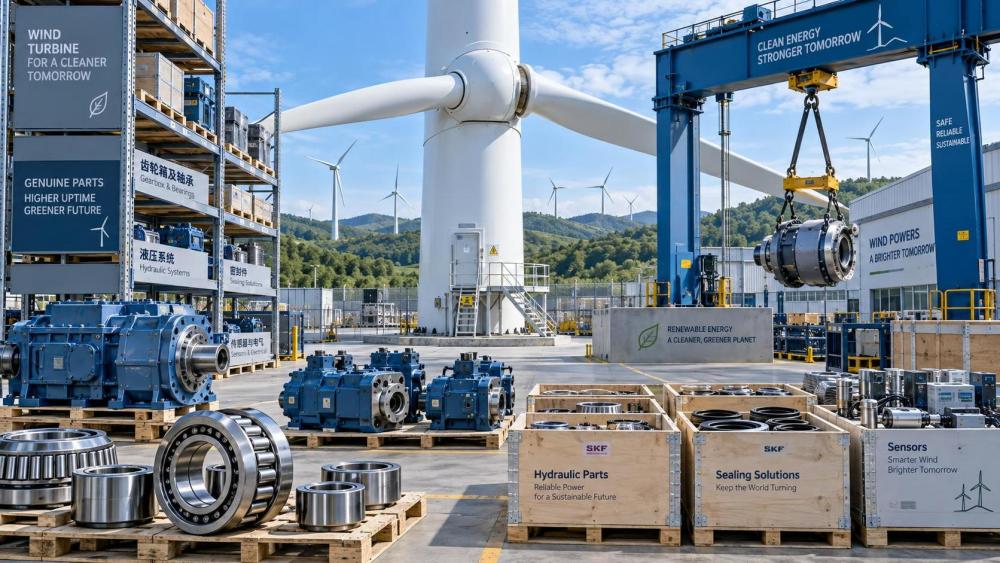
For drivetrain assets, the planning value of monitoring lies in estimating the intervention window. If a developing bearing defect can be safely tracked and scheduled into a lower-wind period, operators may coordinate labor, lifting equipment, seals, lubrication materials, and replacement assemblies. If the defect can progress rapidly or threatens adjacent components, the spare decision must be more conservative. The monitoring system does not replace stock; it determines how much time the supply chain has to respond.
Separate Consumables, Repairable Units, and Strategic Assets
Not every spare should be purchased, stored, and replenished in the same way. Consumables such as O-rings, gaskets, filter elements, grease, fasteners, common seals, and selected hose fittings usually need disciplined identification, shelf-life review where applicable, and easy field access. Their low individual value can hide their importance: an otherwise straightforward repair may be delayed because one compatible seal or fitting is unavailable.
Repairable units require a closed-loop process. Hydraulic pumps, motors, cylinders, yaw gearboxes, pitch drives, electronic modules, and certain transmission assemblies may be candidates for repair or remanufacture, depending on technical condition and approved repair capability. The inventory record should show whether a returned unit is awaiting inspection, repair, quarantine, or release. Treating all removed components as immediately reusable creates serious quality and traceability risk.
Strategic assets include major drivetrain components and long-lead assemblies whose absence could extend an outage far beyond normal maintenance planning. For these items, ownership is only one option. Operators may instead use a shared stock arrangement, framework agreement, supplier-held inventory, repair exchange program, or capacity reservation. The right model depends on fleet size, geographic concentration, contractual obligations, interchangeability, and the credibility of the response commitment. A small isolated site may need more physical assurance than a large cluster of compatible turbines served from a nearby logistics hub.
Lead Time Is a Technical Risk, Not Just a Procurement Field
Supplier lead time is often entered into an enterprise system as a single number. In wind operations, that number can be misleading. A replacement bearing might be available at a manufacturer’s plant, but machining, inspection, preservation, export documentation, special packaging, transport booking, and site access can still delay installation. Offshore work adds vessel availability, port coordination, lifting plans, and weather restrictions. Even onshore projects may face road permits or crane scheduling constraints for large components.
Planning teams should record both normal and disrupted lead times, along with the assumptions behind them. A part sourced through a sole supplier, from another customs territory, or through an obsolete platform deserves a different stock policy from a standard component carried by multiple qualified distributors. Procurement should also confirm whether the quoted lead time applies to a finished spare, a repair slot, or merely a production estimate.
Interchangeability deserves equal attention. Minor design changes in bearings, seals, hydraulic connectors, firmware, cable interfaces, or mounting geometry can make a nominally similar item unsuitable. A spare inventory review should validate fit, form, function, documentation, and required software or calibration steps. The more complex the equipment, the less safe it is to rely on descriptions such as “equivalent” without engineering approval.
Build Stock Around Maintenance Scenarios
The most usable inventory plans are built around real maintenance tasks. Instead of stocking a pitch cylinder alone, consider the full repair scenario: cylinder, compatible seal kit, hydraulic fluid, fittings, hose assemblies if indicated by inspection, retaining hardware, contamination-control materials, lifting aids, test equipment, and documentation. The same principle applies to main bearing work, gearbox inspection, brake-system repair, generator coupling replacement, and hydraulic pump interventions.
Kitting does not mean pre-assembling every possible job. It means identifying the items that repeatedly cause a repair to pause. For remote sites, a well-controlled corrective-maintenance kit can be more valuable than a larger but poorly organized store. Field teams should be able to see what has been reserved for a job, what is available for other turbines, and what must be replenished after work is complete.
Storage conditions also matter. Bearings need appropriate preservation and handling; seals and elastomers can be affected by unsuitable temperature, light, ozone exposure, or incompatible chemicals; electronic modules may require controlled packaging; lubricants require batch and contamination discipline. Large assemblies need periodic preservation checks and a realistic plan for moving them when needed. Inventory that cannot be identified, inspected, or transported safely is not a reliable contingency.
Avoid the Two Common Inventory Errors
The first error is blanket overstocking after a painful outage. It is understandable, especially when a turbine has been idle while waiting for a component. Yet broad stock increases can create obsolete material, duplicate variants, preservation failures, and a misleading sense that the underlying reliability problem has been solved. A post-failure review should ask what actually caused the delay: unavailable material, poor fault detection, unclear part identification, delayed engineering approval, logistics constraints, or lack of installation resources.
The second error is excessive centralization. Regional hubs can reduce duplicate stock and improve professional storage, but they are not automatically suitable for every failure mode. If a site is difficult to reach during winter conditions, or if an offshore campaign depends on a narrow access window, selected local stock may be justified. The decision should reflect the time from failure confirmation to completed repair, not simply the distance between warehouses.
Make Inventory Review a Cross-Functional Routine
Spare planning fails when reliability engineers, technicians, warehouse teams, and buyers work from separate versions of the truth. Maintenance teams know which parts repeatedly delay repairs. Engineers understand failure mechanisms and approved substitutions. Procurement sees supplier constraints and commercial exposure. Warehouse personnel can identify dormant stock, damaged packaging, incorrect master data, and unreturned repairables. These perspectives need to meet in a regular review rather than only after a major failure.
A mature review normally looks at open corrective work, condition-monitoring alerts, recent consumption, overdue repairable returns, changes in supplier lead time, obsolete or superseded parts, and upcoming seasonal work. It should also challenge demand assumptions after major upgrades or operational changes. Inventory parameters that were sensible for a new fleet may be wrong once the turbines age and different failure modes become more likely.
This is where a component-focused knowledge framework is useful. Global Precision Components & Transmission Systems (PCTS) brings together the disciplines that often sit apart in wind maintenance decisions: bearing performance and lubrication, sealing reliability, hydraulic power systems, mechanical transmission, condition monitoring, supplier evaluation, and MRO lifecycle economics. For operators and procurement teams, the value is not a generic parts catalogue. It is the ability to connect a component’s technical behavior with its sourcing risk and repair consequence.
The Right Spare Is the One That Supports a Recoverable Failure
Wind turbine inventory should be planned as part of failure recovery, not treated as a separate warehouse exercise. The strongest plans identify credible failure modes, use fleet and condition data to estimate demand, protect against uncertain lead times, validate configuration compatibility, and ensure that the material can be installed when access is available.
Before increasing stock, operators should test one practical question: if this component failed tomorrow, what exactly would prevent the turbine from returning to service? The answer may be the part itself. Just as often, it is a missing seal kit, an unqualified substitute, a repairable unit still in quarantine, an unavailable crane, or a monitoring alert that arrived too late. Addressing that full chain is what turns spare inventory into a real availability strategy.
Want to dive deeper into these market dynamics, or need data-driven support for your next business move? Drop a line below and let the analysts at PCTS provide customized insights.
We respect your privacy. Your information is strictly confidential.
Related News
- 00
0000-00
How sealing technology reduces contamination in semiconductor manufacturing - 00
0000-00
Where to install vibration sensors on rotating machinery - 00
0000-00
NTSB Probe Finds Boeing Warned of MD-11 Engine Bearing Risk Years Earlier - 00
0000-00
How to size pneumatic grippers for packaging system integration - 00
0000-00
How to size alloy steel power transmission chains for heavy loads
Weekly Insights
Stay ahead with our curated technology reports delivered every Monday.