





Why is Export Compliance Readiness suddenly a 2026 priority?
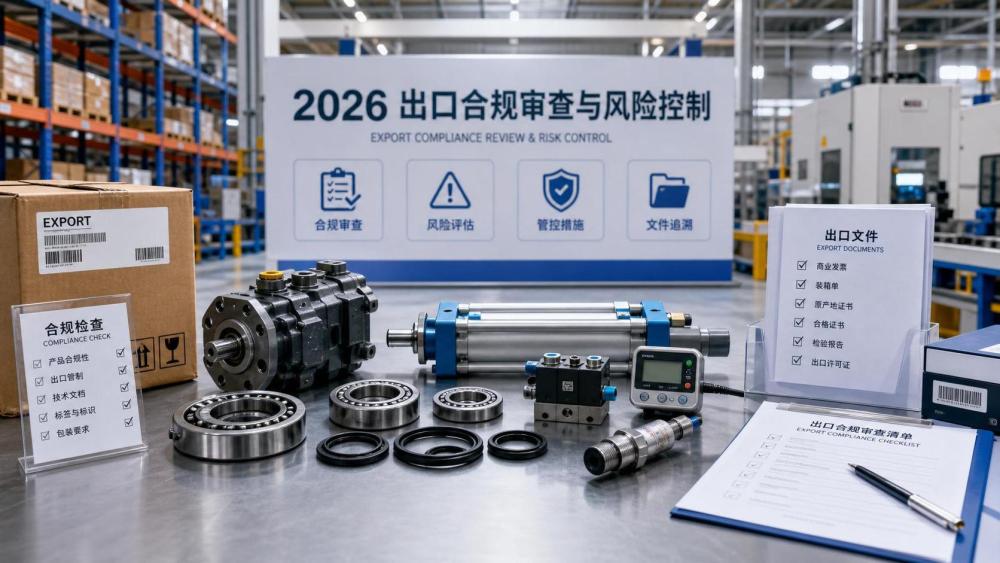
Export Compliance Readiness has moved from a legal back-office issue to a revenue protection issue.
The reason is simple. Cross-border controls are becoming tighter, faster, and more data-driven.
For industrial supply chains, that change affects far more than finished machines.
It also reaches bearings, hydraulic pumps, pneumatic actuators, seals, couplings, belts, chains, and monitoring components.
In practical terms, 2026 risk control means more scrutiny on product classification, end use, end user, routing, documentation, and technology transfer.
That matters in sectors where precision components support energy, automation, transport, defense-adjacent manufacturing, and advanced maintenance systems.
A portal like PCTS reflects this shift clearly.
Its market focus spans precision mechanical parts, fluid power, transmission systems, sealing technologies, and industrial MRO intelligence.
These categories often sit inside larger assemblies, which makes hidden export risk more common than many teams expect.
The real value of Export Compliance Readiness is not only avoiding penalties.
It also supports faster approvals, more reliable customer onboarding, and stronger trust during supplier evaluation.
What does a practical Export Compliance Readiness checklist actually include?
A useful checklist should help teams make decisions, not just collect files.
The stronger approach is to test whether controls work across sales, engineering, logistics, and after-sales support.
Most organizations preparing for 2026 focus on seven control points.
- Clear product classification for every exported item, spare part, kit, and software-linked component.
- A documented screening process for customers, intermediaries, vessel routes, and restricted parties.
- End-use and end-user verification, especially for dual-use or high-performance applications.
- License determination rules with escalation paths for unusual transactions.
- Technical document control, including drawings, specifications, testing data, and remote access records.
- Record retention that matches local rules and supports future audits.
- Training and governance that assign ownership before orders become urgent.
In real operations, weak handoffs usually create the biggest exposure.
A sales team may quote a high-speed spindle bearing correctly, while technical files are shared without review.
A service team may ship replacement seals or valves quickly, without rechecking destination or end-use changes.
That is why Export Compliance Readiness should be tested at transaction level, not only at policy level.
Which industrial products usually need closer review before export?
Not every industrial component carries the same compliance risk.
The more advanced the performance, material, tolerance, pressure rating, or application sensitivity, the closer the review should be.
This is especially relevant in markets covered by PCTS, where components often support mission-critical equipment reliability.
A common mistake is to assume that commodity appearance means low compliance risk.
In reality, a seal, bearing, or coupling may be ordinary in one application and sensitive in another.
Export Compliance Readiness improves when review starts from actual use, not product name alone.
Where do companies usually fail, even when they think controls already exist?
The weak points are rarely dramatic.
More often, they appear in routine exceptions, urgent shipments, distributor requests, engineering samples, and warranty replacements.
One recurring gap is fragmented data.
Classification may sit in one spreadsheet, restricted party screening in another, and shipping instructions inside email threads.
Another gap is overreliance on customer statements without independent review.
That becomes risky when products enter multi-tier distribution or are integrated into larger equipment abroad.
Technical data is another overlooked area.
Drawings, material formulas, pressure curves, diagnostic logic, and test reports may cross borders long before physical goods do.
For precision components, that matters because performance data can be commercially and regulatorily sensitive.
A stronger readiness review usually asks harder questions:
- Can the team stop a shipment quickly when red flags appear?
- Can it explain classification logic during an audit?
- Can it trace who approved document release and why?
- Can it review service parts with the same discipline as original equipment orders?
If the answer is uncertain, Export Compliance Readiness is not yet mature enough for 2026 pressure.
How should Export Compliance Readiness be built into daily operations?
The most effective programs do not treat compliance as a final checkpoint before shipment.
They embed it earlier, where design choices, customer qualification, and service workflows are still flexible.
In practice, three layers matter most.
Start with product intelligence
Build a clean master record for each component family.
That record should connect technical specifications, classification decisions, control notes, and approved documentation versions.
Then align commercial workflows
Quotes, sample requests, distributor onboarding, and replacement orders should trigger the same core checks.
This is especially important for MRO activity, where speed often hides risk.
Finally, create governance that survives exceptions
Approvals need named owners, escalation thresholds, and audit trails.
Without that structure, the program works only when transactions are simple.
A practical decision table can help separate policy language from operational reality.
How can leadership judge whether readiness is enough for 2026?
A useful test is whether the organization can prove consistency under pressure.
If a high-value order, urgent spare part shipment, and remote technical support request arrive together, controls should still hold.
That is the point where Export Compliance Readiness becomes measurable.
Look for evidence in cycle time, exception handling, document traceability, and the quality of red-flag escalation.
It also helps to review whether critical product lines have been mapped by risk.
For example, wind turbine bearings, hydraulic power units, smart monitoring devices, and chemical-resistant sealing systems may require different review intensity.
PCTS-style market intelligence is useful here because compliance decisions rarely stand apart from technical context.
Performance ratings, lifecycle applications, maintenance patterns, and system integration details often shape the true risk picture.
The next step is usually not a full redesign.
More often, it is a focused review of product classification, technical file control, distributor pathways, and service-part workflows.
That kind of targeted checklist creates a more resilient export process and protects cross-border growth without slowing every transaction.
If 2026 controls are already influencing customer due diligence, the right move is to assess current gaps now, prioritize high-risk product families, and set approval standards before exceptions force reactive decisions.
Want to dive deeper into these market dynamics, or need data-driven support for your next business move? Drop a line below and let the analysts at PCTS provide customized insights.
We respect your privacy. Your information is strictly confidential.
Related News
- 00
0000-00
How sealing technology reduces contamination in semiconductor manufacturing - 00
0000-00
Where to install vibration sensors on rotating machinery - 00
0000-00
NTSB Probe Finds Boeing Warned of MD-11 Engine Bearing Risk Years Earlier - 00
0000-00
How to size pneumatic grippers for packaging system integration - 00
0000-00
How to size alloy steel power transmission chains for heavy loads
Weekly Insights
Stay ahead with our curated technology reports delivered every Monday.