





Export Compliance Platform Checklist for Reducing Shipment Delays
Shipment delays often begin long before goods reach the port.
They usually start with missing data, inconsistent paperwork, and weak internal control.
In industrial trade, those issues can disrupt installation windows, production schedules, and customer commitments.
That is why an export compliance platform matters.
It helps teams manage classification, screening, records, and approvals before a shipment becomes urgent.
For businesses moving bearings, seals, hydraulic systems, chains, belts, and other precision components, the right setup reduces preventable delay.
Why Shipment Delays Often Start Inside the Process
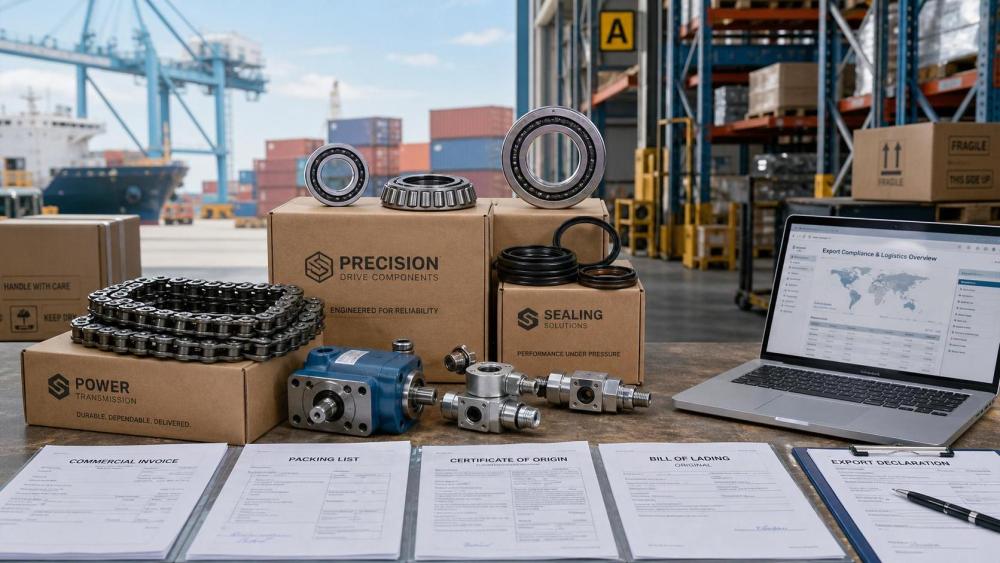
Many export problems are not caused by transport capacity alone.
They begin when technical data, customer details, and shipping documents live in different systems.
A pneumatic actuator may be ready to ship, but classification data is outdated.
A bearing order may pass production, while denied party screening is still pending.
A seal kit may have the right invoice value, but the destination statement is incomplete.
In each case, the issue looks small until the cargo reaches a release checkpoint.
An export compliance platform gives structure to those checkpoints before they create schedule damage.
Core Checklist for an Export Compliance Platform
The best export compliance platform is not just a document archive.
It supports decision-making, exception handling, and fast release under pressure.
Use this checklist to evaluate whether the platform can actually reduce shipment delays.
1. Product Classification Control
An export compliance platform should centralize HS codes, ECCN data, and product-level notes.
This is especially important for technical industrial goods with multiple variants.
Check whether the system can:
- Store classifications by SKU, model, material, and destination
- Track revision history for classification changes
- Flag incomplete or conflicting product records
- Connect engineering updates to compliance review
Without this, one code error can stall a full shipment of components.
2. Restricted Party Screening
Screening must be built into the workflow, not handled as a last-minute task.
A reliable export compliance platform should support:
- Automated screening of customers, intermediaries, and consignees
- Real-time list updates
- Alert handling with documented review steps
- Re-screening when order details change
This matters because shipment data often changes after order confirmation.
3. Destination, End-Use, and End-User Review
A strong export compliance platform should assess more than part numbers.
It should also help evaluate where the goods are going and how they will be used.
Look for features that can:
- Capture destination-specific restrictions
- Record end-use declarations
- Escalate higher-risk combinations automatically
- Maintain approval evidence for audits
This reduces judgment gaps when teams handle complex global orders.
4. Document Accuracy and Version Control
Commercial invoices, packing lists, certificates, and export declarations must match.
In practice, many delays come from simple inconsistencies across those documents.
The export compliance platform should help teams:
- Generate documents from the same data source
- Control edits with approvals and timestamps
- Highlight mismatched values or descriptions
- Prevent shipment release when mandatory fields are missing
That level of control is useful when several teams touch one export file.
5. Workflow Rules and Approval Logic
A useful export compliance platform should reflect actual operating rules.
That means routing low-risk orders quickly and stopping higher-risk transactions automatically.
Review whether the system supports:
- Risk-based approval paths
- Role-based permissions
- Automatic holds on exception cases
- Clear status visibility for every shipment
This keeps compliance from becoming a black box inside the schedule.
Operational Features That Actually Save Time
Some capabilities look minor during software evaluation.
In daily execution, they are often the reason an export compliance platform performs well.
Integration with ERP, PLM, and Shipping Systems
Rekeying data creates errors and slows response time.
An export compliance platform should pull data from commercial and technical systems directly.
For industrial goods, that may include item descriptions, material details, destination terms, and customer records.
Better integration means fewer manual checks and faster release decisions.
Audit Trail and Record Retention
When a shipment is questioned, teams need evidence quickly.
The export compliance platform should show who approved what, when, and based on which data.
That shortens issue resolution and supports future process improvement.
Dashboards for Exception Management
Teams rarely need more raw data.
They need visibility into what is blocked, why it is blocked, and who owns the next action.
A practical export compliance platform should display:
- Pending approvals by age
- High-risk destinations or customers
- Recurring document errors
- Release performance by team or region
This turns compliance into a controllable part of execution.
How to Judge Platform Fit in Industrial Export Operations
Not every export compliance platform fits industrial workflows equally well.
Precision components often involve mixed product families, urgent spare parts, and technical document dependencies.
That creates different demands than standard consumer shipments.
The right answer is usually the platform that simplifies decisions without weakening control.
A Practical Rollout Approach
Even the best export compliance platform fails if implementation is rushed.
A staged rollout usually works better for industrial exporters.
- Map the current export workflow and identify delay points.
- Clean product master data before migration.
- Start with one business unit, route, or product category.
- Measure release speed, error rates, and exception volume.
- Adjust approval logic before wider deployment.
This reduces disruption while building confidence in the controls.
It also shows whether the export compliance platform improves timing in real operations.
Final Checklist Before Selection
Before making a decision, confirm that the export compliance platform can answer these questions clearly.
- Does it reduce manual classification and document review effort?
- Can it prevent incomplete orders from reaching shipment release?
- Does it support fast decisions for spare parts and urgent industrial deliveries?
- Can it provide clear audit evidence during customs or internal review?
- Will it scale across suppliers, plants, and export markets?
An export compliance platform should do more than satisfy policy.
It should protect schedules, improve shipment accuracy, and support reliable delivery performance.
That becomes especially valuable when industrial supply chains face tighter deadlines and less tolerance for error.
If delays keep recurring, the best next step is to review the process through this checklist and identify where the export compliance platform needs to close the gap.
Related News
- 00
0000-00
Where are axial piston pumps used in mining equipment? - 00
0000-00
Embodied AI Robotics and Drive Control Forum Held in Shanghai - 00
0000-00
How does seal service life affect the total cost of ownership? - 00
0000-00
Schaeffler to Cut 3,460 Jobs and Close Five European Plants - 00
0000-00
How does system size affect the price of a belt drive system?
Weekly Insights
Stay ahead with our curated technology reports delivered every Monday.