





Can an Aftermarket Transmission Part Safely Replace an OEM Part?
Can an aftermarket transmission part safely replace an OEM part? In many industrial applications, it can—but only when “replacement” means more than matching a catalogue number, shaft diameter, or mounting pattern. A chain, sprocket, coupling, gearbox bearing, belt, seal, or gear may appear interchangeable on paper while behaving very differently once it is exposed to torque reversals, shock loading, heat, contamination, misalignment, or continuous duty.
For maintenance teams, the question usually arises under pressure: an OEM lead time is long, a production line needs to restart, or a recurring spare-part cost has become difficult to justify. Procurement may see a lower-priced alternative; engineering may see an unknown reliability risk. Neither view is complete by itself. The right decision is based on the component’s function in the system, the consequence of failure, and the evidence available from the alternative supplier.
In industrial power transmission, a part is rarely isolated. A bearing affects gear mesh and shaft position. A belt’s stiffness affects pulley loading. A coupling’s torsional characteristics can change vibration behavior. A seal material can determine whether lubricant stays clean enough for a reducer or hydraulic drive to survive. This is why a safe aftermarket substitution is an engineering and supply-chain decision, not simply a purchasing decision.
“Aftermarket” Does Not Describe One Level of Quality
The term aftermarket covers a wide range of suppliers. Some manufacture components specifically to meet established dimensional, material, and performance requirements. Others offer general-purpose replacements with limited documentation. There are also parts intended for light-duty service that may fit an industrial machine but were never designed for its original duty cycle.
That distinction matters more than the OEM-versus-aftermarket label. An OEM part may be well engineered, but it may also be a standard item supplied through the machine builder’s branded channel. Conversely, a qualified independent manufacturer may produce an equivalent or improved design, particularly where it has deep expertise in bearings, chains, couplings, seals, or machined gearing. The practical question is whether the proposed part meets the actual operating requirement—not whether the packaging carries the original equipment manufacturer’s name.
It is also worth separating “equivalent” from “compatible.” A compatible part can be installed. An equivalent part should deliver comparable function, service life, and safety margin in the intended application. Those are very different claims.
Start with the Consequence of Failure
Not every transmission component deserves the same replacement process. A standard V-belt on a non-critical ventilation unit presents a different risk from a gearbox bearing supporting a high-speed production spindle, a chain on a lifting mechanism, or a coupling in a pump train serving a hazardous process. The cost of the part is often small compared with the cost of an unexpected stoppage, damaged adjacent equipment, environmental release, or personnel exposure.
A useful first step is to classify the part by criticality. Consider what happens if it fails, how quickly failure can be detected, whether the machine has redundancy, and whether a controlled shutdown is possible. Components in safety-related, high-load, high-speed, high-temperature, or difficult-to-access positions normally require more rigorous verification. For low-consequence consumables, an approved alternate may be sensible after a basic fit and performance check.
This is where maintenance history becomes valuable. If an OEM component routinely achieves a predictable service interval, any replacement should be judged against that real baseline. If the existing part fails prematurely because of contamination, poor alignment, lubrication breakdown, or overload, changing brands alone may not solve the underlying problem.
Fit Is Necessary, but Functional Equivalence Goes Further
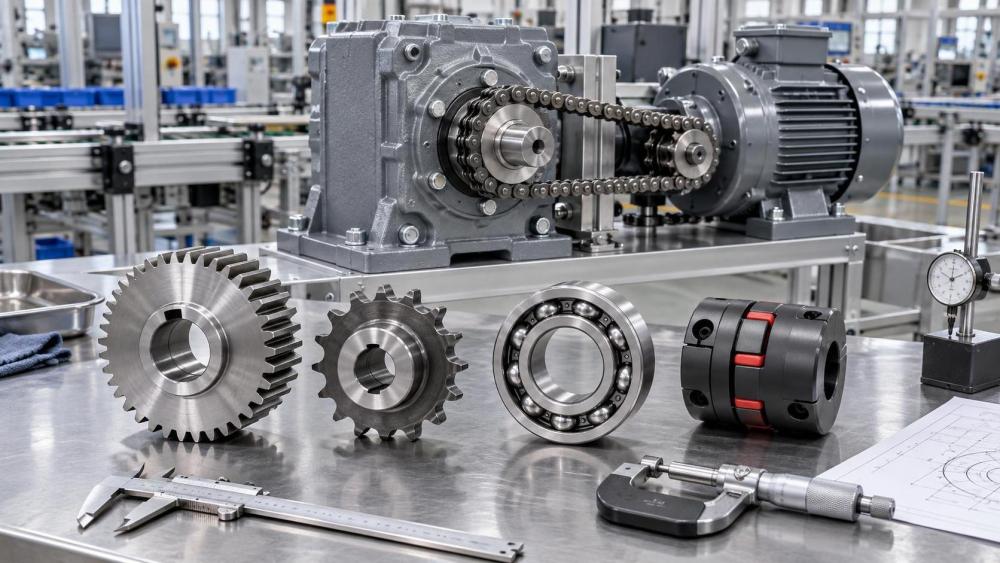
Dimensional verification is the obvious starting point. Bore size, keyway, tooth count, pitch, face width, hub location, mounting holes, shaft tolerance, and clearance dimensions all need confirmation. Yet many transmission failures occur after a replacement has passed the initial installation check.
For gears and sprockets, tooth form, hardness profile, surface finish, runout, and backlash can influence noise, load distribution, and wear. For chains, pitch may match while fatigue strength, pin-to-bushing fit, lubrication retention, and corrosion resistance differ. For belts, nominal length is not enough; profile geometry, cord construction, oil resistance, static conductivity requirements, and allowable tension may be relevant.
Couplings deserve similar attention. A nominally identical flexible coupling may have a different torque rating, torsional stiffness, damping behavior, misalignment capacity, or temperature limit. Installing a more rigid alternative can transmit vibration into bearings and gearboxes. Installing a more flexible one may alter positioning accuracy or introduce transient movement during starts and stops.
Bearings and seals are especially easy to underestimate. Bearing dimensions alone do not establish equivalence in internal clearance, cage design, preload capability, speed suitability, lubrication method, or contamination resistance. A seal that fits a housing may still be wrong for the lubricant, pressure, media, shaft finish, temperature range, or shaft movement. In these cases, “it fits” is often the beginning of the assessment, not the conclusion.
Compare the Operating Envelope, Not the Nameplate Only
OEM documentation may state a part number without revealing every selection assumption behind it. Maintenance and engineering teams should therefore define the operating envelope directly. This includes transmitted torque, rotational speed, start-stop frequency, peak loads, shock loads, duty cycle, ambient conditions, process contamination, lubrication type, and expected alignment condition.
The most important operating condition is often the one that does not occur during normal steady running. A conveyor may experience jam loads. A mixer may reverse direction repeatedly. A crusher drive may see sudden torque spikes. A hydraulic motor drive may transmit pulsation and pressure-induced load changes. An aftermarket part that performs adequately in a clean, steady-duty test may be unsuitable where these transients are routine.
Lubrication compatibility should be checked with equal care. Gear oils, greases, additives, washdown chemicals, and temperature all affect seals, elastomers, friction behavior, and component life. If a replacement requires a different lubricant or maintenance interval, that operational change should be planned rather than discovered after installation.
Traceability Is a Reliability Control
When evaluating an independent source, buyers should ask what can be verified. A credible supplier should be able to identify the product specification, manufacturing origin where relevant, revision status, material or performance information appropriate to the component, and the limits of its interchangeability claim. The depth of documentation will vary by product type, but unexplained substitutions, inconsistent markings, and vague technical answers are warning signs.
Traceability matters because industrial spare parts are not immune to mislabeling, unauthorized copying, or cross-reference errors. A part may be listed under an OEM number while differing in internal construction or intended application. This is particularly risky for critical bearings, high-load chains, precision couplings, hydraulic drive components, and sealing products used with aggressive media.
The evaluation should also include packaging condition, shelf-life considerations for elastomeric parts, storage requirements, and batch control where it affects maintenance planning. A lower purchase price loses its appeal if the receiving team cannot verify what has arrived or if replacement stock cannot be managed consistently across sites.
A Practical Approval Path for Replacement Parts
A controlled qualification process does not need to become bureaucratic. It simply needs to match the risk. For a potentially suitable aftermarket transmission component, the following sequence is often more useful than an immediate fleet-wide switch:
- Confirm the exact OEM reference, machine model, drawing revision, and any modifications made during the equipment’s service life.
- Record the functional requirements: load, speed, duty cycle, environment, lubrication, alignment, and safety consequence.
- Compare drawings, ratings, materials, interfaces, and application limits rather than relying only on a distributor cross-reference.
- Review whether use of a non-OEM part affects equipment warranties, service contracts, regulatory obligations, or internal maintenance procedures.
- Where risk is manageable, trial the part on a controlled asset and monitor temperature, vibration, noise, lubricant condition, wear, and installation behavior.
- Document the approved alternative clearly so that future purchasing does not substitute a superficially similar but unqualified item.
Condition monitoring can make this process stronger. Baseline vibration readings, thermal checks, oil analysis, and inspection intervals provide evidence after installation. They also help distinguish a part-quality issue from a system issue such as soft foot, shaft runout, poor tensioning, excessive contamination, or an overloaded drive.
When OEM Supply Is Usually the Safer Default
There are circumstances where staying with the OEM source is the prudent choice, at least until a thoroughly supported alternative has been qualified. These include proprietary assemblies with undocumented interfaces, parts integrated with electronic controls, components subject to a machine-builder warranty, and applications where failure can create a serious safety, quality, or environmental event.
OEM supply may also be preferable when the original manufacturer has made design revisions that are not visible from the outside. A revised gear set, bearing arrangement, seal geometry, or heat-treatment specification can be linked to changes elsewhere in the machine. Replacing only one element with an older or generic equivalent may disturb the intended system balance.
This does not mean independent sourcing has no role in critical equipment. It means the evidence threshold should rise with the consequence of error.
Look at Total Cost of Ownership, Not Unit Price
The financial case for an aftermarket part should include more than the initial saving. Consider lead time, inventory availability, installation labor, expected maintenance interval, energy loss from poor alignment or belt slip, collateral damage risk, downtime exposure, and the administrative cost of managing multiple sources. A well-qualified alternate can improve resilience when OEM delivery is constrained. A poorly qualified one can create repeated shutdowns and consume far more resources than it saves.
For many plants, the best strategy is not an all-or-nothing decision. They may retain OEM parts for highly critical assemblies, approve specified alternatives for standard wear items, and develop a second source for selected components with clear technical documentation. This creates supply flexibility without treating every replacement part as interchangeable.
Global Precision Components & Transmission Systems (PCTS) approaches this issue through the connected disciplines behind machine reliability: tribology, mechanical transmission, fluid power, sealing technology, condition monitoring, and MRO economics. For buyers and maintenance professionals, component comparison is most useful when it connects catalog information to the machine’s real load path, service environment, and failure history.
The Decision Should Be Evidence-Based
An aftermarket transmission part can safely replace an OEM part when its fit, functional performance, operating limits, quality controls, and traceability have been verified for the application. It should not be approved merely because another part looks similar or because it has worked in a less demanding machine.
Before changing a source, gather the OEM reference, equipment details, operating conditions, maintenance records, and available technical documents. Then ask a focused question: if this part differs from the original, does the difference reduce the safety margin or change the machine’s behavior? If the answer cannot be supported with credible information, the apparent saving may be an avoidable risk.
Want to dive deeper into these market dynamics, or need data-driven support for your next business move? Drop a line below and let the analysts at PCTS provide customized insights.
We respect your privacy. Your information is strictly confidential.
Related News
- 00
0000-00
How to check vibration analysis software for sensor compatibility - 00
0000-00
IndexBox Forecasts 3.8% Annual Growth for Global Radial Seals Market Through 2035 - 00
0000-00
How to assess the chemical compatibility of FFKM sealing sheets - 00
0000-00
IndexBox Forecasts 3.6% Annual Growth for Construction Bearings Market - 00
0000-00
When do hydraulic components require an export license?
Weekly Insights
Stay ahead with our curated technology reports delivered every Monday.