





A beam saw spare-parts order should begin with the maintenance history, not the last emergency purchase. Repeated belt adjustments, intermittent carriage faults and unexplained lubricant consumption can point to different purchasing needs. Ordering another replacement without understanding the record may leave the underlying problem untouched.
For procurement teams, the task is to turn maintenance observations into a defensible buying plan: which drive components need replacing, which deserve a stocked spare, and which should remain on a supplier-supported replenishment arrangement. That decision depends on the installed machine configuration, evidence of deterioration, production consequences and replacement lead time—not simply how often a part appears on an invoice.
Build a record that identifies the component and the problem
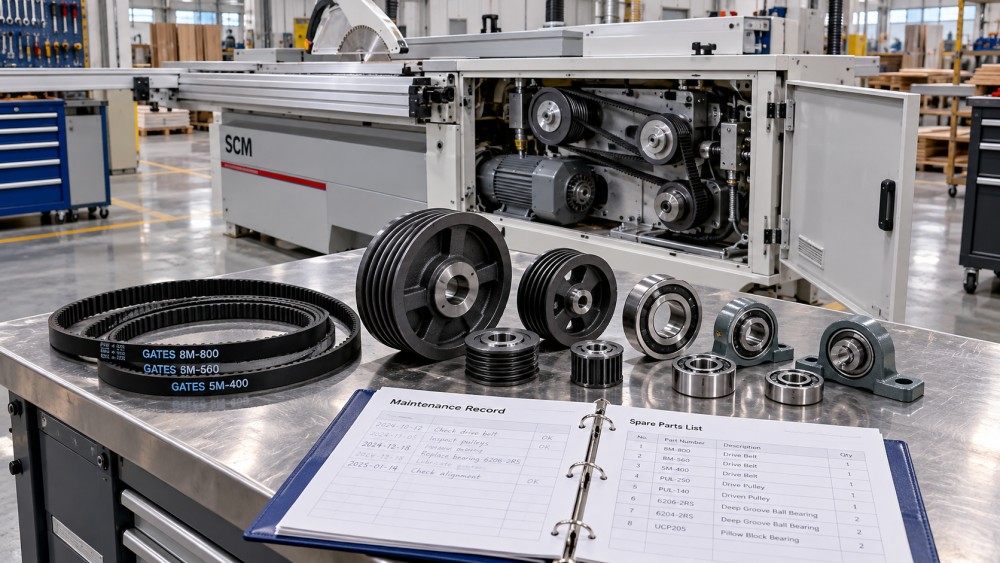
“Drive inspected” is not enough information to support a purchase. A useful entry identifies the machine, affected assembly, operating conditions, observation and follow-up action. It should distinguish the main saw drive from carriage travel, panel positioning and other powered movements fitted to that particular machine. Their parts and failure consequences are not interchangeable.
Use the beam saw maintenance checklist as a reference when organizing drive and lubrication checks, while keeping the machine manufacturer’s instructions as the authority for inspection methods, lubricant specifications and service limits. Procurement needs the resulting observations connected to identifiable components, rather than a checklist consisting only of completed boxes.
A purchasing-ready maintenance entry should capture:
- Asset identity: machine model, serial number, assembly location and installed component identification.
- Operating context: recorded operating hours where available, shift pattern, material mix and relevant changes in duty.
- Observed condition: belt damage, leakage, unusual noise, measured temperature or another clearly described finding.
- Inspection basis: measurement method, operating state and comparison with the applicable manufacturer’s requirement.
- Intervention: adjustment, cleaning, lubrication, replacement or further diagnosis, including who performed it.
- Follow-up result: whether the symptom disappeared, persisted or returned after a recorded period of operation.
Keep suspected causes separate from confirmed findings. “Possible bearing noise” should not become “bearing failure” merely because a requisition needs a description. That distinction helps buyers avoid ordering an expensive assembly before maintenance has established what actually needs replacing.
Read drive and lubrication findings together
A drive complaint does not automatically justify a drive-component purchase. Bearing condition, lubrication, alignment and installation can interact. SKF’s Bearing Maintenance Handbook, particularly its sections on lubrication, inspection and troubleshooting, describes these relationships and supports investigating operating conditions rather than treating a symptom as a complete diagnosis.
The procurement implication is straightforward: request enough diagnostic evidence to distinguish a replacement need from a maintenance correction. An unusual sound alone is a weak purchasing specification. An identified component, documented inspection result and maintenance recommendation provide a much stronger basis.
This table is a purchasing triage tool, not a diagnostic procedure. Inspection and repair decisions remain with qualified maintenance personnel using the applicable machine documentation.
Lubricant descriptions deserve the same discipline as mechanical part numbers. Record the approved product or specification, application point and service method. SKF’s handbook explains that lubricant selection and replenishment depend on operating conditions; a generic description such as “bearing grease” is therefore insufficient for a purchase order. Where a substitution is proposed, require technical approval covering the application and compatibility with the existing lubricant.
Separate recurring consumption from unresolved faults
Historical usage can support inventory planning, but only after the records are classified. A part replaced during scheduled service is different from one damaged during installation, replaced during troubleshooting or removed after an unrelated incident. Treating every issue from stores as normal consumption can create misleading demand.
For each frequently purchased drive item, procurement and maintenance should review the reason for replacement. Was deterioration confirmed? Did the replacement resolve the problem? Was the removed part examined? Did a second component require attention shortly afterward?
Consider a hypothetical saw with repeated belt purchases. If the records show unresolved pulley damage, increasing belt stock addresses availability but not the repair scope. The more appropriate requisition may combine the confirmed replacement components with a planned maintenance window. If the records instead show predictable wear under a stable workload, holding the correctly specified belt may be reasonable.
Compare service history against a meaningful exposure measure where possible. Calendar months alone can conceal differences between a heavily used saw and a lightly used backup machine. Operating hours, shifts or production cycles may provide better context, provided the site records them consistently. Do not create precise replacement forecasts from incomplete or incompatible records.
Decide what to stock by downtime exposure, not price alone
A low-cost part can stop production, while an expensive assembly may be available quickly through an established service channel. Inventory decisions should consider the consequence of unavailability alongside condition evidence and supply constraints.
Assess each candidate spare against four practical questions:
- Production consequence: Does its failure stop the saw, restrict a function or allow work to move to another machine?
- Recovery time: How long do diagnosis, sourcing, transport, installation and recommissioning take?
- Supply certainty: Is availability confirmed for the exact revision, or merely indicated for a similar product?
- Stockholding burden: What storage, preservation, inspection and obsolescence risks accompany ownership?
These questions support different purchasing arrangements. Documented recurring demand may justify a routine stock item. A machine-specific component with a difficult supply route may warrant a contingency spare despite infrequent use. An expensive, repairable assembly may be better supported through an exchange agreement, provided compatibility, availability and return conditions are confirmed.
Shared spares across several saws require verified interchangeability. Similar appearance or matching motor power does not establish equivalence. Maintain an approved cross-reference that identifies the machines and configurations each stocked item actually supports.
Reorder planning should use the site’s observed demand and current supplier lead times. Allow separately for uncertainty rather than burying it in an unexplained quantity. Where maintenance history is too limited for a reliable forecast, document the stock decision as a risk judgment and review it after subsequent inspections or replacements.
Write specifications that prevent near-match deliveries
A maintenance record becomes commercially useful when it connects to a controlled bill of materials. Each stocked or purchased spare should have an internal item number, manufacturer identification where available, applicable machine serial range and revision status. Photographs can help identification, but should supplement—not replace—technical documentation.
The required detail depends on the component. For a belt, request the manufacturer’s designation and applicable matching requirements. For a bearing, confirm the complete designation, including relevant suffixes. For a motor or gearbox, use the approved assembly specification rather than power rating alone. For an electronic drive, establish the approved hardware and configuration requirements before accepting an alternative.
Ask suppliers to state deviations explicitly. A quotation described as “equivalent” should identify what differs and provide supporting documentation for engineering review. Procurement should not accept responsibility for deciding whether a changed bearing clearance, mounting arrangement or control interface is technically acceptable.
Where an original part has been superseded, require written confirmation of the replacement relationship and any associated installation requirements. A replacement assembly may require additional components or setup work; whether it does must be established for the specific machine, not assumed from a catalogue description.
Compare quotations on the complete repair requirement
Unit price can obscure differences in scope. One quotation may cover a bare component, while another includes the approved assembly, accessories or configuration service. Normalize the quotations against the maintenance work order before comparing commercial terms.
A practical comparison includes freight, required ancillary parts, commissioning support where applicable, warranty conditions and any exchange-unit obligations. For repairable items, clarify evaluation charges, repair authorization limits, turnaround commitments and what happens if the returned unit cannot be repaired. Treat unconfirmed lead times as an open risk rather than a planning promise.
The work package should also identify who will perform installation and functional checks. In US workplaces covered by OSHA’s general-industry requirements, servicing involving unexpected energization or stored-energy hazards falls under the applicable energy-control provisions of 29 CFR 1910.147. Other jurisdictions have their own requirements. A spare-parts order does not replace the site’s maintenance authorization and energy-isolation procedures.
Receiving inspection should verify identity, quantity, visible condition and the agreed documentation before the item enters available stock. Label machine-specific or revision-sensitive parts clearly. Preserve the packaging and storage instructions supplied with the component, and keep electronic assemblies and lubricants under their specified storage conditions. An unopened box is not, by itself, proof that an item remains suitable for installation.
Close the purchasing loop after installation
The most useful purchasing evidence arrives after the replacement has been fitted. Maintenance should record the installed part number, relevant setup work, functional-check result and whether the original symptom remains. If a substitute was approved, preserve that approval with the asset record rather than leaving it only in an email thread.
Stores should distinguish parts actually consumed from unused returns, repairable cores and items removed for examination. Otherwise, inventory history may suggest demand that never occurred. Procurement can then review whether the stocked quantity, supplier arrangement and quoted lead time still match operational needs.
A sound drive-spares plan links three records: the observed condition, the authorized repair scope and the verified replacement item. When those agree, purchasing can distinguish a justified contingency spare from a speculative order—and recurring consumption from a fault that still needs resolving.
Technical references: SKF, Bearing Maintenance Handbook, sections covering lubrication, inspection and troubleshooting; Occupational Safety and Health Administration, 29 CFR 1910.147—The control of hazardous energy (lockout/tagout). Machine-specific service limits, replacement specifications and lubricant requirements should be taken from the applicable manufacturer documentation.
Want to dive deeper into these market dynamics, or need data-driven support for your next business move? Drop a line below and let the analysts at PCTS provide customized insights.
We respect your privacy. Your information is strictly confidential.
Related News
- 00
0000-00
How sealing technology reduces contamination in semiconductor manufacturing - 00
0000-00
Where to install vibration sensors on rotating machinery - 00
0000-00
NTSB Probe Finds Boeing Warned of MD-11 Engine Bearing Risk Years Earlier - 00
0000-00
How to size pneumatic grippers for packaging system integration - 00
0000-00
How to size alloy steel power transmission chains for heavy loads
Weekly Insights
Stay ahead with our curated technology reports delivered every Monday.